#1 IN POSTPARTUM CORE RECOVERY
Most C-Section Moms Fighting Their "Shelf" Are Fighting the Wrong Thing. I Was, Too.
If you've been left with a fold above your C-section scar that won't go away, if binders dig right into your incision, or if no diet or workout has changed its shape, please read this before you book a consultation with a surgeon. It isn't fat: it's a muscle that lost its nerves during the surgery and a scar that pulls, and both can be fixed.
 By Dr. Emily Carter, Women's Health & Pelvic Floor Specialist

"Emily, my daughter just turned four, and this fold above my scar looks exactly the same as the day they stitched me up. Do I just have to live with it, or should I book a tummy tuck?"
A mom asked me that in my office last week, her shirt still lifted and her eyes fixed on the floor. I told her what nobody told me after my own two C-sections:
"Neither. But you do have to stop doing what you're doing, because some of it is making it worse."
I've spent my whole career treating women after childbirth: the pelvic floor, the abdomen, the back. And still, after my own two C-sections, I carried a shelf above my scar for six years that folded over every pair of pants I owned. I blamed genetics, my age or the idea that "that's just what a C-section does," until the day a colleague ran her fingertip across the top of my scar and asked me a question that changed my life.
That's why I'm writing this today. Further down, I'll show you that exact same check, which you can do at home in 30 seconds, so you can find out if the same thing is happening to you that was happening to me.
Binders Squeeze the Outside, but the Problem Is on the Inside, Right Under Your Scar
This is the problem nobody explains to you, and it explains everything.
The hospital binder, the one from the pharmacy or the one a friend recommended only squeezes your belly from the outside. And on top of that, it squeezes right where it bothers you most: over your incision.
But what actually holds your belly in, or what has stopped holding it in, is a muscle on the inside: a deep muscle that wraps around your waist like a corset. And in a C-section, that muscle sits right where the cut was made.
That's why the binder flattens you while you're wearing it, and the moment you take it off, the shelf drops right back over your scar. It never did anything for the muscle that's supposed to hold you in.
On the forums where C-section moms talk, the stories sound so alike that I could have written them myself after my second C-section:
"I've lost 40 pounds since my C-section. My legs and arms are slim, but that fold is still hanging over my scar. I don't know what else to do."
"Five years later, the skin above my scar is still numb. I can't feel anything when I touch it, and my belly folds right there."
"I wear high-waisted pants so they'll hold it in, and when I sit down, a roll forms right above my scar. I hate sitting down in front of people."
"My husband says you can't even tell. But I see it in every photo, in every mirror and every time I bend down to pick up my son."
These are women who eat well, who exercise and who did everything they were told after their C-section. And they still feel guilty for not seeing results.
What Nobody Told You, and What Changes Everything

You can spend months doing core work, walking every day, counting every calorie or going to Pilates, and the shelf stays exactly the same. The binder squeezes your incision, rides up within an hour, and the moment you take it off, everything drops back, because it never fixed anything. It only hid the problem for a few hours.
And the cruelest part is that crunches, sit-ups and the classic planks can make it worse. They squeeze the outer muscles, push your belly forward, and the shelf bulges out right above your scar. Millions of C-section moms do them convinced they're helping their body, without knowing they're making it worse.
| WHAT YOU THINK IT IS | WHAT IT REALLY IS |
|---|---|
| Stubborn fat above your scar | A muscle that lost its nerves in the cut |
| Extra skin that has to be cut off | Skin without collagen over a scar that pulls |
| Something more dieting or core work will fix | Something neither diet nor exercise can reach |
| Something only a tummy tuck can fix | Something you can work on from the outside, without being opened up again |
| Your fault, for not trying hard enough | Not your fault: nobody ever explained it to you |
More than 20,000 women have already found the answer with the PowerBelt by Skinklean, with no diets, no surgery and no pain.
The Signs I Recognize, Because I Lived Them Too

If the shelf is there the moment you wake up, before you've eaten anything, that isn't bloating: it's a muscle that isn't holding you in.
If the skin above your scar is still numb years later, as if you were touching it through a glove, that isn't just "a C-section thing." Those are nerves that were cut, and not only the ones in your skin.
If a roll forms right above your scar every time you sit down, if you spend the day fixing your shirt, or if family dinners end with a pillow on your lap, that's the scar pulling inward and everything above it folding over it.
And there's one detail that's really hard to explain: the scar feels hard and tight, like a seam sewn too tight. Sometimes it pulls when you stretch, and by the end of the day your back hurts. It isn't your age. It's a muscle that isn't holding you in and a scar that barely gets any blood.
Then Came the Appointment That Changed Everything With One Question

I'd gone in for a check-up that had nothing to do with my belly, or so I thought.
After examining me, my colleague slowly ran her fingertip across the skin above my scar, from one side to the other, and asked me very calmly:
"Emily, you can't feel that, can you?"
She was right. Six years later, that strip of skin was still numb. I shrugged. "That's normal after a C-section. I tell my patients that every day."
"It's common," she answered, "but it isn't normal. And it isn't just the skin. To get your baby out, they opened you layer by layer, and that cut also took out the nerves of the deep muscle that holds your belly in. Your brain sends the signal and it never arrives, the same way your leg doesn't answer when it falls asleep and you tell it to move. That's why everything pushes outward. And the scar pulls inward like a seam sewn too tight, so everything the muscle lets out folds right over it. That's your shelf."
And then she said the sentence that changed everything: "Your scar healed, Emily. The muscle under it didn't. Most C-section moms with a shelf aren't fighting fat. They're living with a muscle that lost its nerves and a scar nobody has ever treated."
I didn't say anything for a long time. And then I started crying on the exam table, right in front of her. It wasn't sadness, it was relief, because I finally understood it wasn't my fault. Nobody had ever explained it to me, not even me, and this is what I do for a living.
I Could Have Saved Myself Six Years of Shame If Someone Had Told Me Sooner
What I thought was "C-section fat" was a muscle without a signal and a scar that pulled. It had stayed that way after my first one, got worse after my second, and nobody ever treated it.
There's one detail almost everyone misses: you can get back to your exact pre-pregnancy weight, without a single extra pound, and still have the shelf. That's because the problem isn't your weight. It's what's going on under your scar.
After a C-section, three things happen at once, and none of them fixes itself. The first is that the deep muscle loses its signal, because the cut took out its nerves, and without a signal it doesn't hold you in, no matter how much you exercise. The second is that the scar gets very little blood, so it stays hard and pulls inward, and everything above it folds over it. And the third is that the skin above it, which stretched for nine months, is left without collagen and hangs over the line of the cut.
That's why everything you tried only went halfway. Diet goes after fat, and this isn't fat. Crunches work the outer muscles, which aren't the ones that lost their signal. The binder squeezes the skin from the outside, and does it right over your incision. And a tummy tuck cuts off the extra skin and stitches you up from the outside, but it doesn't give the signal back to the muscle underneath or the blood back to the scar. That's why so many women come out of it with more numb skin than before and the same back pain. It's an expensive, long and painful surgery, in the exact spot where you were already opened once.
The cut severed the nerves of the deep muscle, so it stopped holding you in and everything pushes out.
The scar pulls in like a tight seam, so everything above it folds right over it.
Lie on your back with your knees bent. Slowly run your fingertip across the skin right above your scar, from one side to the other. If you feel a numb strip, as if you were touching yourself through a glove, those are nerves that were cut during your C-section.
Then place your hand on the shelf and cough gently. If you feel your belly pushing out against your hand instead of firming up and pulling in, that's the muscle that lost its signal.
"Use It, and Come Back to See Me in 6 Weeks."

I wasn't looking for a miracle, just something that actually did what it promised. I didn't want another binder digging into my incision, another 12-week core program, scar creams or a $10,000 quote to go back under the knife in the same spot. And I didn't want three clinic appointments a week either, because no mom with kids can keep that up.
What my colleague told me to do is what physical therapists have been doing for decades. When someone has knee surgery, the thigh muscle often "forgets" how to contract. They don't tell the patient to try harder. Instead, they place electrodes on the muscle and send the signal straight in, until the muscle remembers how to work. The muscle under your scar is exactly the same. In France, in fact, every new mom is sent to postpartum rehab, and electrical stimulation is part of it.
"You can do this at home now," she told me. "Twenty minutes a day, lying on your couch."
And she told me about a belt that does on your couch exactly what we do in the clinic. It's designed for moms in exactly your situation: you put it on in a minute, you lie down, and it works on the three things a belly needs after a C-section, in the right order. Without squeezing your scar at any point.
I ordered it that same night, and I promise you, it's what changed my life completely. It's called the PowerBelt, from the brand Skinklean.
First, heat. A C-section scar gets very little blood, which is why it stays hard and tight. The heat brings that blood back and softens it little by little, so it stops pulling inward. And it gets the muscle underneath ready to work, because a cold muscle responds terribly.
Second, 850-nanometer red and infrared light, for the skin above your scar, the skin that stretched and was left hanging. This light gets the skin making collagen again, so it pulls in along with the muscle and stays firmer and smoother instead of folding over. German researchers measured it with ultrasound: after treating the skin with this light, collagen density went up 34%. In the group without the light, nothing changed.
And third, the signal: 20,000 contractions per session, straight into the deep muscle that lost its nerves in the cut. You don't have to do anything, because the belt does it for you.
I was skeptical, I really was. This is what I do for a living, and I've seen hundreds of cheap belts that only tickle the skin. But more than anything, I was exhausted from looking in the mirror and seeing that fold, so I said yes.
I Didn't See Anything the First Few Days. And Then…
On the first day, I felt a really nice warmth over my scar, and then a strong squeeze deep inside, right underneath it, in a spot I hadn't felt since my first C-section. It didn't hurt at all, not even on the scar, but I lay there completely still, not quite believing it. Even so, there was no change in the mirror yet, and there wasn't any on day three or day five either. I was starting to have real doubts, until day eight.
On Day Eight, Something Happened
I sat down to breakfast in the high-waisted jeans that always gave me a roll right above my scar, and I realized I didn't have to fix my shirt. The shelf wasn't folding over the waistband. It wasn't anything dramatic, but it was there.

I put my hand over my scar, the way I always did to cover it in photos, and for the first time in six years, there was nothing to cover. I cried, not from joy, but from relief.
Six Weeks Later, Results I Didn't Expect

My colleague examined me again. The scar was soft, it didn't feel like a tight seam anymore, and the fold above it, where two fingers used to fit, was almost gone. I'd lost an inch and a half off my waist and, for the first time since my C-sections, I recognized my own side profile in the mirror.
But what changed the most wasn't my silhouette. It was that I stopped living around the shelf: how I sat, what I wore and where I stood in photos. And the backache I used to get every afternoon was gone too, because there was finally a muscle holding me in from the inside.
Those twenty minutes on the couch had become my ritual. It was the only time of the day when nobody needed anything from me and, for once, something was taking care of me.
On the same C-section forums where I'd read so many desperate stories, I finally posted my own: "Six weeks, on my own body. The shelf doesn't fold over my pants anymore, my scar is soft, and I feel like me again." The replies came in by the dozen, from moms writing: "Send me the link."
6 weeks, on my own body. The shelf doesn't fold over my pants anymore, my scar is soft, and I feel like me again.
♥ 198 · 74 repliesSend me the link 🙏
Which one is it?? Two C-sections here and the exact same shelf
Okay I need this. Link please!
Two C-sections and a shelf no binder could hide. What surprised me most was feeling something deep inside, right above my scar, in an area that had been numb for years. A few weeks in, my pants stopped giving me that roll when I sat down.
I was terrified it would bother my scar, because I still can't stand even the waistband of my underwear touching it. All I felt was warmth and a squeeze deep inside. Now it's my time of the night, and I never skip it.
I had an appointment to get a tummy tuck quote. I cancelled it three weeks after I started using this. My husband asked me what had changed, because I looked more like me.
My last C-section was twelve years ago, and I was convinced there was nothing left to do. I was wrong. My scar feels soft for the first time in years, and I don't hold my purse in front of my belly when I sit down anymore.
I'd already bought two cheap belts that just tickled. This one is nothing like them: you feel the warmth and the squeeze really deep inside. And what I didn't expect was that the backache I had every afternoon would go away.
It Works Even If Your C-Section Was Years Ago, or If You've Had Three
A lot of the moms who write to me have been living with the shelf for years: one C-section, two, even three, with a horizontal or a vertical scar.
"All three of my kids were born by C-section. My youngest is ten now, and I still have the same fold. I know it isn't fat, but I don't understand what it is."
That's exactly why the PowerBelt works where training can't reach. At the gym, you can only train the muscles your brain can find, and the one under your scar lost its nerves, so no workout reaches it. The answer isn't more crunches or another surgery, but giving it its signal back from the outside.

And if you've been living with it for years, no, it's not too late. The muscle doesn't know what year it is, and as soon as it gets its signal back, it starts working again. It doesn't matter if you had one C-section or three, or if your scar is horizontal or vertical.
The Belt That Took the Shelf Out of My Mirror
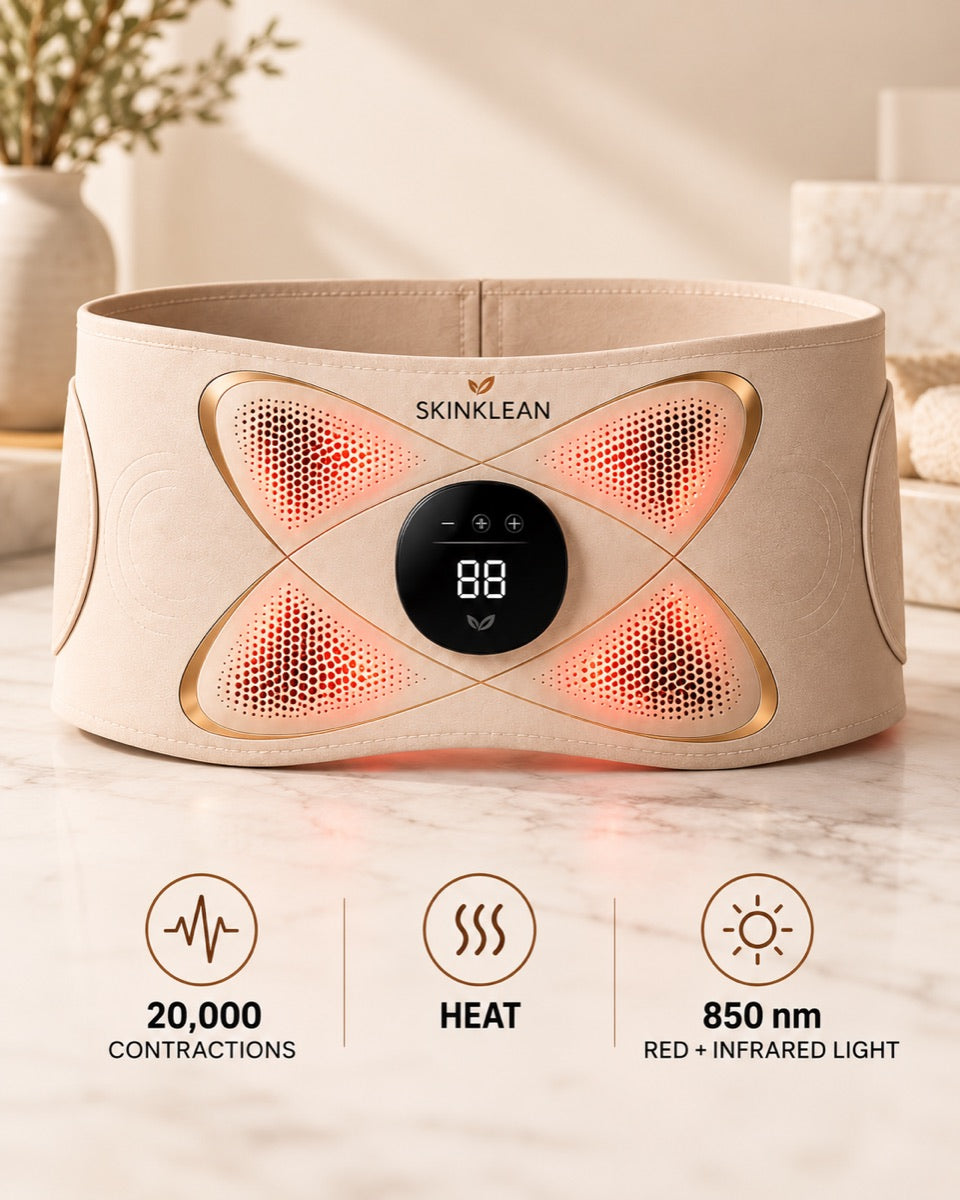
- 20,000 contractions per session, straight into the muscle that lost its nerves in your C-section, without you having to do anything.
- Heat, which brings blood back to your scar so it softens and stops pulling.
- 850 nm red and infrared light, which gets the skin above your scar making collagen again: 34% more, measured by ultrasound.
- Nothing squeezing your incision: you don't wear it all day, it's twenty minutes lying down.
- Twenty minutes on your couch, with no gym, no appointments and no need for a babysitter.
- FDA-cleared.
- No replacement gel pads: you pay once and that's it, with no monthly costs.
Watch out for the cheap belts that look similar and are all over the internet, because they only tickle your skin and never reach the muscle. All they want is your money. Only order it on the official Skinklean website, using the button below.
+50% OFF PLUS FREE GIFTS$239.99 Today $159.99
It works out to less than $2.70 a day, less than your morning coffee.
- +50% OFF, today only and while stock lasts
- Free gifts with your order
- Fast shipping: it ships the same day
- 60-Day Core Challenge: your money back if your shelf doesn't change
If You've Read This Far, Your Shelf Can Still Change
A year ago, I was exactly where you might be today: tired of covering my belly with my hand in photos, and convinced it was permanent, that it was "the price of a C-section," or that the only way out was going back under the knife.
I'd read it a hundred times on the forums, and I'd even heard it in my own office.
But it isn't fat, it isn't permanent, and it isn't your fault.
It's a muscle that lost its signal and a scar nobody treated, and both respond to the right tool. Not to diets, not to crunches and not to another scar on top of the one you already have.

Today I wear fitted dresses without thinking about how I'm going to sit, I stand in the front row in photos and, above all, I feel like myself in my own body again, with the confidence I'd lost for so long. I'm not "the one with the shelf" anymore. I'm me again.
🛡️ The 60-Day Core Challenge
Use it twenty minutes a day for 60 days, and if your shelf doesn't change, the brand refunds every last dollar, with no questions and no hassle. They're so sure of what they offer that almost nobody sends it back, so you have everything to gain and nothing to lose.
Frequently Asked Questions
Is it safe to use over my scar?
Yes. It's FDA-cleared, it doesn't squeeze your scar but warms it, and you start at the gentlest level and only go up when you're ready. Thousands of C-section moms use it every night on the couch.
Does it hurt?
No. First you feel a pleasant warmth, and then a strong squeeze deep inside, and it doesn't hurt, not even around the scar. It has multiple intensity levels, so you start with the lowest one and go up as you get used to it.
How long do I use it, and when?
Twenty minutes a day, lying down, whenever it suits you. Most moms use it on the couch at night, once the kids are asleep.
My C-section was many years ago. Will it still work?
Yes. It doesn't matter if it was last year or twenty years ago. The muscle doesn't know what year it is: as soon as it gets its signal back, it starts working again.
Does the shelf come back when I stop using it?
No. This isn't a binder that holds you in while it's on and lets go when it comes off. What it does is get the muscle under your scar working again and soften the scar, and a muscle that's working again holds you in on its own, whether you're wearing the belt or not. Even so, a lot of moms keep using it, because those twenty minutes have become their time of day.
Isn't a tummy tuck the only real fix?
That's what you're often told, and it's exactly what keeps so many C-section moms stuck for years. A tummy tuck costs five figures and weeks of recovery, they open you up again in the same spot, and it doesn't give the signal back to the muscle underneath. The PowerBelt works out to less than $2.70 a day, is used on your couch and, if it does nothing for you, you get your money back. It's what you try before going back into surgery.
How is this different from cheap EMS belts?
Cheap belts just tickle the skin and never reach the muscle underneath. On top of that, almost all of them run on gel pads that dry out and have to be bought again every month. The PowerBelt combines heat for your scar, 850 nm light for your skin and deep muscle stimulation, it's FDA-cleared, and there are no replacement pads: you pay once, and that's it.
Is it worth the money? I hate spending on myself.
Almost every mom says the same thing: they never put themselves first. So here's the simple math. It costs less than all the binders, scar creams and programs already sitting in your drawer that did nothing, and a fraction of the surgery you were told was your only way out. There are no monthly costs. And if it does nothing for you, you get your money back. You're allowed to spend this on you.
What if it doesn't work for me?
Then it costs you nothing, because you're covered by the 60-Day Core Challenge: you use it for 60 days, and if your shelf doesn't change, you get every last dollar back.
Dr. Emily Carter is a Women's Health & Pelvic Floor Specialist and a mom of two children born by C-section. She took the shelf out of her mirror after six years.
PowerBelt by Skinklean · 4.8/5 · FDA-cleared · 60-Day Core Challenge · Fast shipping.